

Hipo
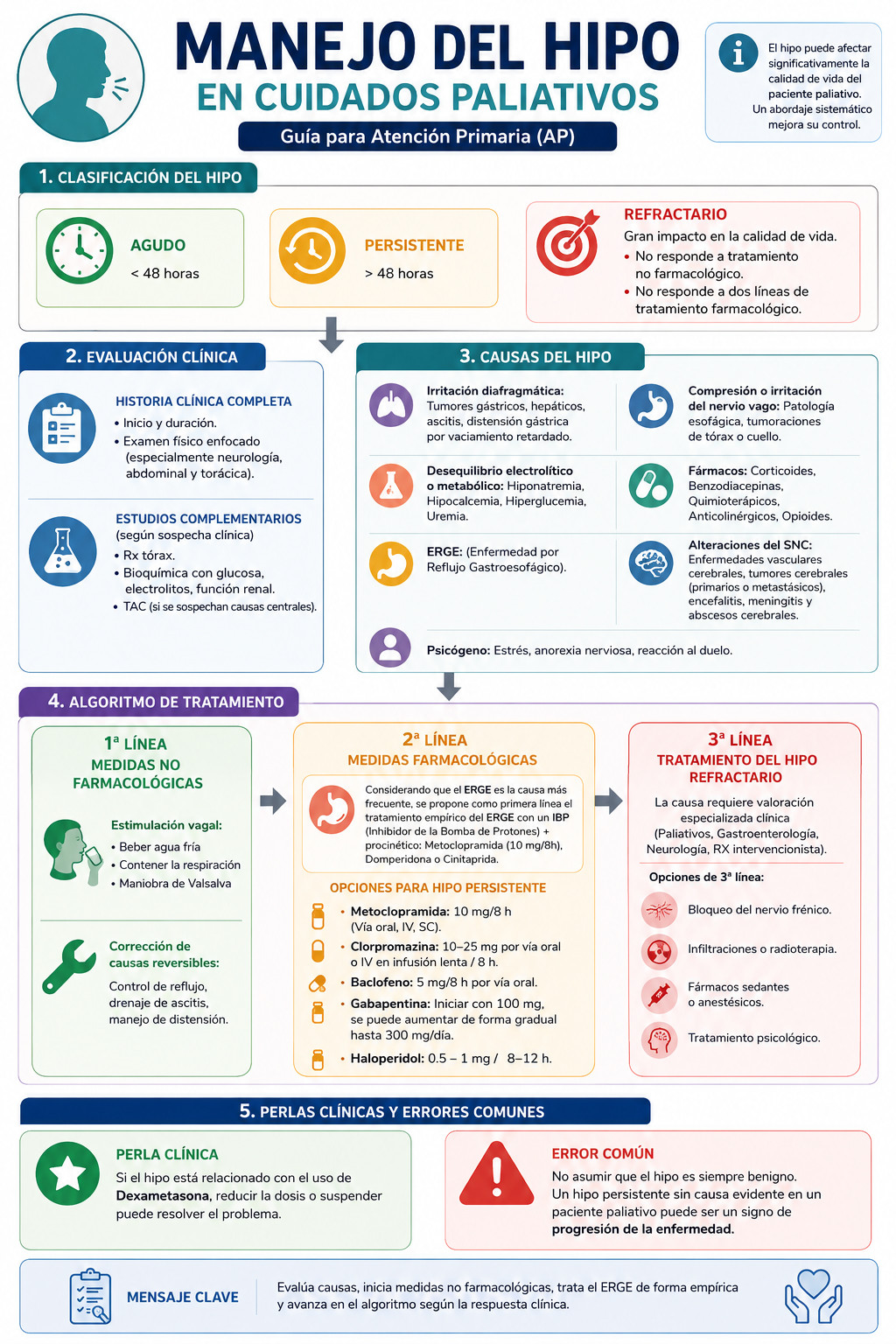
Infografía clínica de la guía original.
Mostrar bibliografía
- 1. Steger M, Schneemann M, Fox M. Systemic review: the pathogenesis and
pharmacological treatment of hiccups. Aliment Pharmacol Ther. 2015;42(9):1037-50.
doi: 10.1111/apt.13373. - 2. Ough YD, Sheikh A. Hiccups: A Case Presentation and Review. J Palliat Med.
2010;13(5):589-91. doi: 10.1089/jpm.2009.0303. - 3. Marinella MA. Diagnosis and management of hiccups in the patient with advanced
cancer. J Support Oncol. 2003;1(2):121-30. - 4. Campbell AJ, Birnbaum RJ. Hiccups: Evaluation and treatment [Internet]. London:
BMJ Best Practice; 2020 [citado 14 de julio de 2026]. Disponible
en: https://bestpractice.bmj.com/ - 5. Chernov A, Agar M. Hiccups in palliative care: pathophysiology and treatment. Curr
Opin Support Palliat Care. 2018;12(4):420-6. - 6. Porzio G, Verna L, Vultaggio P, et al. Haloperidol for treatment of persistent hiccups in
patients with cancer. J Pain Symptom Manage. 2011;42(2):302-6. - 7. Kushner A, Krevsky B. Persistent hiccups. Gastroenterol Hepatol. 2007;3(2):101-3.
- 8. Kaye K, Shah M, Jethwa A, et al. Management of persistent hiccups in palliative care:
A systematic review. J Pain Symptom Manage. 2021;61(1):154-62. - 9. Twycross R, Wilcock A. Palliative Care Formulary. 7th ed. Haywards Heath: Palliative
Care Matters; 2021. - 10. D'Orsi G, Sacco F, De Luca R, et al. Neurological Management of Persistent Hiccups:
A Systematic Review. Curr Neurol Neurosci Rep. 2022;22(2):103-11. - 11. Borrelli S, et al. Management of Palliative Care Patients with Chronic Hiccups: A Case-
Based Review. J Palliat Care. 2023;38(4):511-7. - 12. Asociación Española de Enfermería en Cuidados Paliativos (AECPAL), Sociedad
Española de Pediatría Paliativa (PEDPAL), Sociedad Española de Cuidados Paliativos
(SECPAL), Sociedad Catalano-Balear de Cuidados Paliativos. Manual control de
síntomas en pacientes con cáncer. Madrid: SECPAL; 2019. p. 217-26.
Referencias reproducidas tal como aparecen en la guía. Pág. 32.